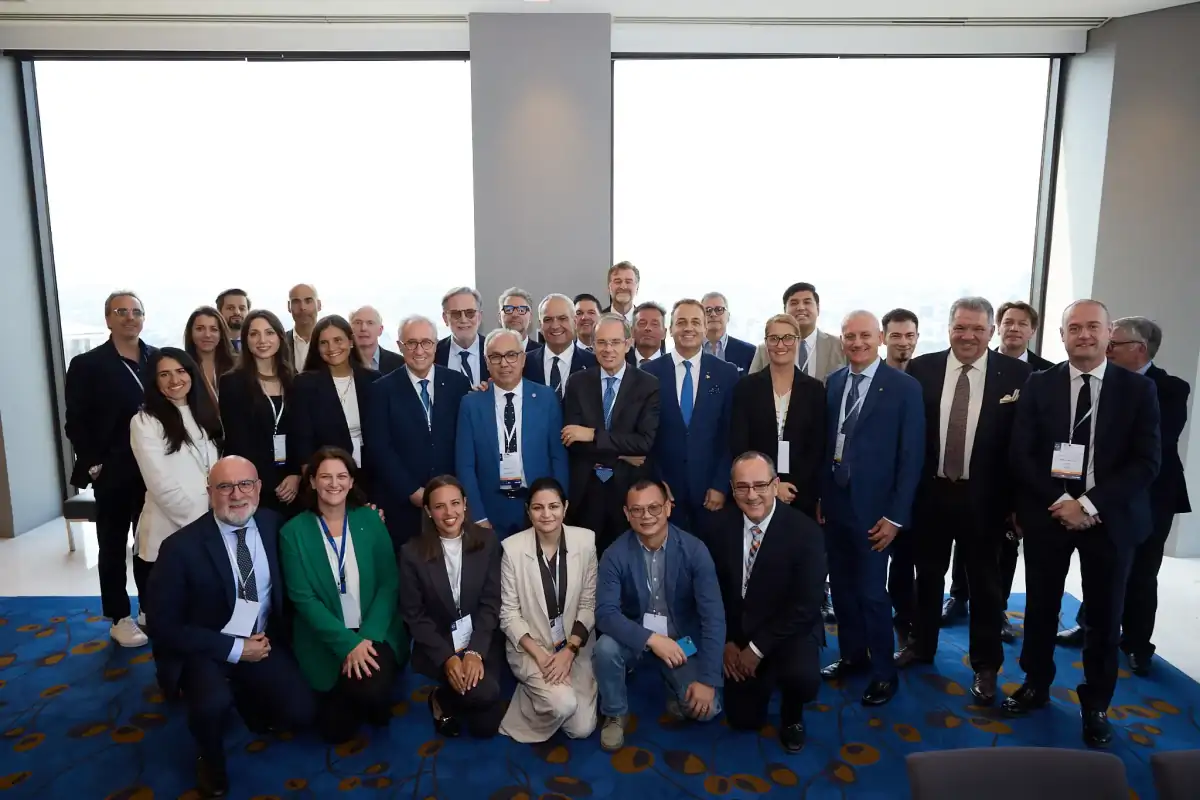
During the meeting, an engaging conference was held under the title “The GenAI Multiplier", aimed at analysing how Generative Artificial Intelligence is reshaping economic systems and organisational models. Generative AI is quickly moving from a trial technology to a structural element of economic transformation, and the presentation examined how intelligence embedded in business processes can materially affect productivity, corporate competitiveness and long-term growth prospects. Rather than being only a further step of automation, GenAI appears as a multiplier of capabilities, with the potential to magnify human contribution at systemic scale.
According to the figures reported during the session, Generative AI could generate up to USD 4.4 trillion of additional annual value worldwide. In a global economy where GDP is expected to be around USD 117 trillion in 2025, this would amount to roughly a four percentage-point uplift over baseline trajectories. Comparable estimates have been published by major research centers and industry actors such as McKinsey & Company and OpenAI, which highlight significant impacts across many industrial sectors. Outcomes will vary with the speed of adoption and the regulatory context, yet the direction is clear: GenAI is becoming an enabling infrastructure for a new productivity paradigm.
Unlike previous automation waves that targeted mainly manual and repetitive tasks, GenAI acts directly on cognitive processes and knowledge work. A substantial portion of the workforce may see important parts of their job transformed or accelerated by generative tools, and in many cases these tools reduce execution times without lowering quality. This trend points to an emphasis on augmentation and capability enhancement rather than pure substitution. Sectors with high knowledge intensity — from software engineering to marketing, from operations to professional services — are already experiencing measurable gains in efficiency and innovation capacity.
Despite the proliferation of pilots and experiments, a real gap remains between occasional use and full, systematic implementation. Many organizations have started GenAI projects, but only a minority have integrated these solutions into core processes and governance models. To unlock the full multiplier effect, companies need organizational redesign, strong strategic alignment from leadership, investments in data quality, robust risk management, and structured reskilling programs.
The implications go beyond mere productivity increases. GenAI enables a progressive decoupling between organizational leverage and headcount: leaner teams, supported by intelligent systems, can perform tasks that previously required much larger structures. This dynamic is likely to reshape firm architecture, boost the competitiveness of SMEs and alter international competitive balances. For countries with an export and innovation focus, the ability to adopt and integrate GenAI effectively can become a strategic differentiator.
In this scenario, the role of the Italian Chambers of Commerce Abroad gains particular importance, especially in a dynamic and technologically advanced region such as the Asia Pacific and, within it, the Chinese market. Inspired by reflections on the possible contribution of the International Chamber of Commerce, the Chambers can act as platforms that connect Italian companies with local innovation ecosystems, investors and regulatory authorities. They can promote best practices for GenAI adoption, organise specialist training, and facilitate dialogue among large companies, SMEs and startups.
For the Italian Chamber of Commerce in China, this means a concrete program of support to members: timely briefings on regulatory updates, practical guidance on data governance and AI compliance, curated introductions to local technology partners and research centers, and targeted initiatives such as conferences, roundtables, business missions and networking events. By doing so, the Chamber can help build an Italian Chinese community of practice around digital innovation, reinforcing the strategic positioning of Italian firms and supporting their competitiveness in a very advanced and fast-evolving market environment.
The conference concluded with a roundtable that offered additional industrial and economic perspectives, featuring contributions from Mario Margotta, Giuseppe Barca and Richard Ralphsmith. The discussion underlined a simple but important message: the multiplier effect of GenAI will not happen by itself. It will depend on organizations’ capacity to integrate technology, strategy and human capital development in a coordinated and forward-looking way.
Generative Artificial Intelligence has ceased to be merely theoretical; it is now an ever more embedded component of global economic processes. For Italian companies active on international markets, and particularly in China, the challenge is not whether GenAI will affect their sector but how they will govern its impact with awareness and strategy. Those who move beyond pilots to structured, responsible and strategic adoption will help define the next chapter of growth, innovation and competitive advantage.